Tuesday, February 2, 2010
PM phones Altaf, discusses Karachi unrest
Monday, February 1, 2010
Obama proposes $1.2 bln to aid Pakistani military
Friday, December 18, 2009
Gas shortfall exceeds 300 million cubic feet
Sunday, December 13, 2009
Pakistan must pressure Afghan Taliban: Petraeus
Thursday, December 10, 2009
Another CCTV footage of Moon Market blast on Geo TV
LAHORE: Another CCTV footage of the blast in Lahore’s Moon Market has been obtained by Geo TV.The footage shows images of people running in confusion and security alarms of the parked vehicles going off after the blast.
Another CCTV footage of Moon Market blast on Geo TV
LAHORE: Another CCTV footage of the blast in Lahore’s Moon Market has been obtained by Geo TV.The footage shows images of people running in confusion and security alarms of the parked vehicles going off after the blast.
Thursday, December 3, 2009
India rejects involvement in Balochistan
Tuesday, December 1, 2009
SC to hear petitions against NRO from Dec 7
Saturday, November 28, 2009
U.N. board votes to censure Iran
In a rare of show of global solidarity, nations demanded a halt now to enrichment work.
By Glenn Kessler and Joby Warrick
Washington Post
WASHINGTON - The resounding censure of Iran yesterday by the board of the International Atomic Energy Agency, the U.N. nuclear watchdog, signals the start of a potentially more confrontational phase in the Obama administration's dealings with the Islamic republic, including the prospect of strengthened U.S.-led efforts to cut off Iran's economic links to the world.
Iran will face a "package of consequences" if it does not soon become a "willing partner" in talks on its nuclear ambitions, a senior U.S. official warned, speaking on condition of anonymity. "We hope Iran takes note of that clear message.
The 35-nation board approved, 25-3, a resolution rebuking Iran for its continued defiance of U.N. resolutions that demand a halt to uranium enrichment and other activities that U.S. officials think are aimed at developing nuclear weapons. The declaration is particularly critical of Iran's secret construction of a second enrichment plant inside mountain bunkers near the ancient city of Qom, southwest of Tehran.
The resolution, which was supported by China and Russia, two longtime skeptics of taking a hard line against Iran, said the government's failure to notify the IAEA of the project was a "breach of its obligation" under U.N. treaties.
The resolution will be referred to the U.N. Security Council, which has the authority to enact sanctions against the country. During the Bush administration, China and Russia worked to soften sanctions against Iran during negotiations in the Security Council.
Iranian officials called the IAEA resolution "a historic mistake" and threatened to curtail their cooperation with the agency. Tehran has said the nuclear program is intended only to produce electricity.
In devising additional means of pressuring Iran, U.S. officials are focused on making it difficult for Iranian companies to ship goods. They are thus targeting insurance and reinsurance companies that underwrite the risk of such transactions, especially businesses that help support Iran's military elite. Such measures would build on an approach initiated by the Bush administration and by three sets of existing U.N. sanctions against Iran.
"Nothing that we contemplate or that we would consider is aimed at causing greater harm for the Iranian people, who have suffered enough," the U.S. official said.
When President Obama took office, he said that he would seek to engage Iran - and that Tehran would have until the end of this year to demonstrate it would respond seriously.
Obama reached out in speeches and issued a video message to the Iranian people. He sent two private letters to Iran's supreme leader, Ayatollah Ali Khamenei, the country's key decision-maker in matters of security and foreign policy, and joined with Russia and France in offering to help supply new fuel for an aging medical reactor in Tehran. But the missives have gone largely unanswered - apart from public scorn from Iranian leaders - and the reactor deal has not won government approval.
After months of effort, one of the few tangible achievements the administration can point to is the willingness of China and Russia to support yesterday's resolution.
Wednesday, November 25, 2009
Arroyo vows justice as massacre toll rises
Updated 12 minutes ago
Philippine President Gloria Arroyo has vowed to hunt down the perpetrators of a political massacre that left 57 people dead, as one of her allies was named the prime suspect.
Ms Arroyo faced increasing pressure to take decisive action as more bodies were pulled out of shallow graves and relatives of the victims reported horrifying details of the killings, including that two women shot dead were pregnant.
"This is a supreme act of inhumanity that is a blight on our nation," Ms Arroyo said in a statement as she declared Wednesday a national day of mourning.
"The perpetrators will not escape justice. The law will hunt them until they are caught. No citizen in our nation should ever have to fear for his or her life in the free expression of political will.
"Police earlier said the top suspect in the massacre was Andal Ampatuan Jnr, a member of Ms Arroyo's ruling coalition and the son of a powerful regional politician who has helped secure votes for the president in previous elections.
"According to the initial reports, those who were abducted and murdered at Saniag were initially stopped by a group led by the mayor of Datu Unsay," national police spokesman Chief Superintendent Leonardo Espina said.Ampatuan Jnr is the mayor of Datu Unsay in Maguindanao province, a lawless part of the southern Philippines where Muslim clans have long waged vicious campaigns against each other to grab power.
The massacre occurred after about 100 Ampatuan gunmen allegedly abducted a convoy of aides and relatives of a rival politician, Esmael Mangudadatu, plus a group of journalists.
The victims were abducted as they were travelling in a six-vehicle convoy to nominate Mr Mangudadatu as the opposition candidate for provincial governor in elections next year. He was not in the convoy.
They were shot at close range, some with their hands tied behind their backs, and dumped or buried in shallow graves on a remote farming road close to a town bearing the Ampatuan name.
Ampatuan Snr had been grooming his son to take over as governor of Maguindanao, and the victims' relatives have alleged the Ampatuans organised the murders so that Mr Mangudadatu would not run for governor.
Mr Mangudadatu said the body of his murdered wife had been horrifyingly mutilated and that his dead sister and aunt had both been pregnant.
"We can't call an animal because I have pets and they are tame. No, he is a monster. They are monsters," Mr Mangudadatu told reporters, referring to Ampatuan Jnr and his gunmen.
The death toll rose from 46 to 57 after 11 more bodies were pulled out of shallow graves on Wednesday, according to police.
The victims included at least 13 local journalists who had been intending to report on Mr Mangudadatu's governorship nomination.
The ruling coalition's candidate for next year's presidential election, ex-defence secretary Gilberto Teodoro, said the Arroyo administration must pursue the attackers, "whether they are political allies or not".
The Philippine Commission on Human Rights chairwoman, Leila De Lima, also called for immediate action by the president, describing Ampatuan Jnr as a "warlord".
- AFP
Tuesday, November 17, 2009
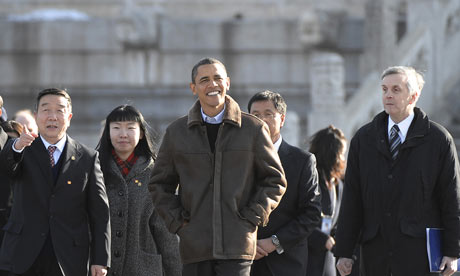
Barack Obama tours the Forbidden City, home of China's emperors
Barack Obama took a break from bilateral discussions this afternoon to play tourist at the Forbidden City, one of China's best-loved historical sites.
The authorities closed off the former imperial palace in Beijing so the US president could spend almost an hour undisturbed in its maze of vermilion buildings and courtyards, explored by millions of visitors each year.
Dating back to the 15th century, the complex was home to 24 Chinese emperors who ruled for almost 500 years, between 1420 and 1911.
"It's a testament to the greatness of Chinese history," said Obama, who had put on a jumper and a brown sheepskin jacket to ward off the Beijing chill. Snow dotted roofs and there were patches of ice in the courtyards.
Obama said it was "a magnificent place to visit" and he wanted to return with his wife and daughters, adding that he would like to visit other parts of the country. This is his first trip to China.
Standing in the Hall of Supreme Harmony – where Ming and Qing dynasty emperors held their enthronements and weddings – he asked the museum curator, Zheng Xinmiao, to explain to him the characters on the board hanging in the middle of the hall, Chinese media reported.
Zheng explained that it read "Jian Ji Sui You", meaning "Emperors should make good rules". The principle seems equally applicable to presidents, although Obama may sometimes yearn for the kind of domestic power the Forbidden City's former occupants enjoyed.
The site, now known as the Palace Museum, is in the heart of the capital and covers approximately 150,000 square metres.
Obama is due to visit a stretch of the Great Wall near Beijing tomorrow, before flying out to South Korea for the last stretch of his four-nation tour of Asia.
Monday, November 2, 2009
Stigma part of breast cancer's grip on poor
WASHINGTON – Nurses were training women in rural Mexico to examine their breasts for cancer when one raised her hand to object. If she lost her breast, Harvard public health specialist Felicia Knaul recalls the woman saying, "My man would leave me" — and with him, the family's income.
International cancer specialists meet this week to plan an assault on a troubling increase of breast cancer in developing countries, where nearly two-thirds of women aren't diagnosed until it has spread through their bodies.
Adding to the problem, some worrisome data suggests that breast cancer seems to strike women, on average, about 10 years younger in poor countries than it does in the U.S. No one knows why.
"Today in most developing countries you see a huge bulge of young, premenopausal women with breast cancer," says Knaul, who heads Harvard's Global Equity Initiative and was herself diagnosed at age 41 while living in Mexico.
"We should help them to know what they have and to fight for their treatment."
But from Mexico to Malawi, stigma like Knaul witnessed a few weeks ago may prove as big a barrier as poverty.
"One of the trainers said, 'If he'd leave you for that, he's not worth having,'" says Knaul. But she acknowledged that will be a hard message for some women's economic realities.
"It's not a trivial consideration," agrees Dr. Lawrence Shulman of the Dana Farber Cancer Institute, who is part of a team working to begin cancer care in parts of Africa where "the women are often seen as really either vessels for producing children or as sex slaves."
But some success in treating HIV and tuberculosis in those areas has him "hopeful we can make a difference. I don't think it's a pipe dream."
Tuesday, Knaul and Shulman bring together international task force of health specialists and prominent charities to begin planning a two-pronged approach.
First, train midwives and other rural health providers to perform regular breast exams, using the power of touch in places where mammography machines simply are too expensive. That won't catch the very smallest tumors, but specialists agree it could improve diagnosis dramatically in some areas.
Second, the task force will start negotiating lower prices for generic chemotherapy for poor countries, following the same model that has helped transform AIDS care in parts of Africa.
You don't need in-country cancer specialists to administer that chemo, says Shulman — just a network of oncologists who can provide help or instruction to local health officials by e-mail or phone, as he has advised colleagues in Malawi.
Breast cancer long has been considered a cancer mostly of wealthier countries. Indeed, about 192,000 new cases are expected in the U.S. this year, where long-term survival is high thanks in part to good screening.
The true prevalence in most developing countries is unknown, because of poor diagnosis and bad record-keeping. But new Harvard research estimates they'll be home to 55 percent of the world's 450,000 expected breast cancer deaths this year.
The report predicts the poorest countries will experience a 36 percent jump in breast cancer by 2020.
One problem: In wealthy countries, earlier diagnosis can lead to breast-saving surgery instead of breast removal. Even countries like Rwanda and Malawi have clinics that perform mastectomies if patients can travel to the capitals, Shulman says. But few have radiation equipment, making breast-conserving surgery there not an option yet. (He is hunting a radiation unit for Rwanda but says that's in the very earliest stages of planning.)
Mexico is a mixed situation, with radiation, other treatments and diagnostic mammography available in some places. That's how Knaul — whose husband is a former health minister of Mexico — was diagnosed, early enough that mastectomy and chemotherapy give her good odds.
But she fumes that while Mexico's poor and rural women often get Pap smears to check for cervical cancer, "no one even suggests they check your breasts" at the same visit. She founded an advocacy group — Cancer de Mama — to help, noting that Mexico's insurance program for the poor covers breast cancer care but they must get diagnosed first.
EDITOR's NOTE — Lauran Neergaard covers health and medical issues for The Associated Press in Washington.
Saturday, October 31, 2009
Clinton continues push for Mideast peace
Clinton was to make a personal plea for the two sides to resume peace talks even as U.S. officials acknowledged they saw little prospect for an immediate breakthrough.
Over the course of the summer, President Barack Obama had hoped for a fast track to renewed peace negotiations, but Clinton reported to him on Oct. 22 that neither side had taken sufficient steps toward resuming the dialogue.
Clinton arrived in Abu Dhabi in the early hours Saturday after completing a three-day visit to Pakistan.
Obama held a three-way meeting with Netanyahu and Abbas in New York in September, hoping it would prod them to relaunch talks that broke off more than a year ago. But in her report to the president in October, Clinton indicated that while the Palestinians had strengthened security efforts and reforms of Palestinian institutions, more needed to be done to prevent terror and to stop those who carry out or encourage attacks on Israel.
Clinton intends to consult with a range of Arab foreign ministers on the Israel-Palestinian stalemate when she attends an international conference in Morocco on Monday and Tuesday.
After her meeting with Abbas in Abu Dhabi, Clinton was headed for Jerusalem for talks that were expected to include not only Netanyahu but also his foreign minister, Avigdor Lieberman.
Lieberman suggested recently the Israelis and Palestinians come up with a long-term interim arrangement that would ensure stability, while at the same time putting off a final deal.
He has recommended leaving the toughest issues — such as the status of disputed Jerusalem and a solution for Palestinian refugees who lost homes in the conflict — "to a much later stage."
Clinton also was expected to meet with Israeli Defense Minister Ehud Barack.
In an interview with the British Broadcasting Corp. before leaving Islamabad on Friday, Clinton downplayed the prospects for a quick breakthrough, while stating that former Sen. George Mitchell, the administration's special envoy on Mideast peace, was still pushing.
The effort to get Israel and the Palestinians back to the negotiating table has been further complicated by responses to international calls for an independent inquiry into Israel's fierce offensive against Palestinian militants in the Gaza Strip last winter. A U.N. report by respected South African jurist Richard Goldstone, accused Israel and Palestinian militants of committing war crimes during the three-week operation.
The report, which was adopted by the U.N. Human Rights Council earlier this month, recommends war crimes proceedings if the sides do not conduct credible independent investigations into their actions.
Gaza's rulers, the Islamic militant group Hamas, dismissed Clinton's visit as "destined to fail."
Spokesman Sami Abu Zuhri said the U.S. could not effectively engage in peacemaking while ignoring Hamas, which came to power in Palestinian elections in 2006 and then seized power in Gaza in 2007. The Obama administration says it won't engage with Hamas until it drops its refusal to accept Israel's right to exist and meets other preconditions.
Kidnappers demand $2 million for Irish hostage
MANILA, Philippines – Captors of a 79-year old Irish missionary kidnapped in the southern Philippines have released a video in which the priest says his abductors are demanding $2 million to release him.
The video was obtained by government negotiators and broadcast on GMA television network in Manila Saturday. It shows Rev. Michael Sinnott holding a copy of the Oct. 22 issue of the Philippine Daily Inquirer newspaper. That was 11 days after his abduction.
Sinnott appeals in a weak voice to President Gloria Macapagal Arroyo, the Irish government, his fellow missionaries and friends "who may have pity ... to help so that I can get out of here as soon as possible."
Gunmen seized Sinnott in southern Pagadian city in Zamboanga del Sur province on Oct. 11 in the latest hostage crisis to grip this predominantly Roman Catholic nation.
It remains unclear who is holding Sinnott. The volatile south has grappled with decades of Muslim separatist unrest, and militants have conducted kidnappings in the past but have denied involvement in Sinnott's abduction.
Allan Molde, spokesman for the provincial Crisis Management Committee handling the hostage crisis, said the video was handed to a law enforcer on the committee by one of its operatives Saturday.
Molde said he recognized Sinnott on the video.
"He's well, he's OK, but you can see the sadness in his face," Molde said by telephone from Pagadian.
He said it appeared that Sinnott, who has grown some facial hair, was reading from something that was handed to him.
The GMA TV report says Sinnott identified the leader of the group that kidnapped him as Abu Jamdal, but Molde said he wasn't familiar with the person.
The video was taken outdoors, and a piece of tablecloth or bedsheet was placed behind Sinnott as a background. No other person was shown but one hand could be seen helping Sinnott hold up the newspaper.
Molde declined to comment specifically on the ransom demand, but said: "As you know, our government has invoked the non-ransom policy."
The GMA report said that in the video, Sinnott lamented that he could not take all the medicines he needed. The priest has previously undergone heart bypass surgery.
Molde said medicines have been sent through emissaries but he could not confirm that they had actually reached the missionary.
Molde said he had informed Sinnott's superior at the Missionary Society of St. Columban in the southern Philippines.
Iran lawmakers reject UN-drafted uranium plan
The UN-brokered plan requires Iran to send 1.2 tons (1,100 kilograms) of low-enriched uranium — around 70 percent of its stockpile — to Russia in one batch by the end of the year, easing concerns the material would be used for a bomb.
After further enrichment in Russia, France would convert the uranium into fuel rods that would be returned to Iran for use in a reactor in Tehran that produces medical isotopes.
Iran has indicated that it may agree to send only "part" of its stockpile in several shipments. Should the talks fail to help Iran obtain the fuel from abroad, Iran has threatened to enrich uranium to the higher level needed to power the research reactor itself domestically.
The Tehran reactor needs uranium enriched to about 20 percent, higher than the 3.5 percent-enriched uranium Iran is producing for a nuclear power plant it plans to build in southwestern Iran. Enriching uranium to even higher levels can produce weapons-grade materials.
Boroujerdi, who heads the parliament's National Security Committee, said the priority for Iran was to buy nuclear fuel and hold on to its own uranium. He also said there was no guarantee that Russia or France will keep to the deal and supply nuclear fuel to Iran if Tehran ships them its enriched uranium.
"The preferred option is to buy fuel ... there is no guarantee that they will give us fuel ... in return for enriched uranium. We can't trust the West," ISNA quoted Boroujerdi as saying.
Kazem Jalali, another senior lawmaker, said Iran wants nuclear fuel first before agreeing to ship its enriched uranium stocks to Russia and France even if it decides to strike a deal.
"They need to deliver nuclear fuel to Iran first ... the West is not trustworthy," the official IRNA news agency quoted him as saying.
Jalali said Iran needs fuel and putting conditions to deliver it for the research reactor is unacceptable.
"Countries possessing fuel are required, under international rules, to provide fuel for such reactors. Putting conditions is basically wrong," he said.
Jalali said these conditions for the fuel was teaching Iran new lessons.
"Western approach toward Iran's demand for fuel is only straightening Iran's resolve to continue its peaceful nuclear program," he added.
He said Iran holds a 10 percent share in a Eurodif nuclear plant in France purchased more then three decades earlier but is not allowed to get a gram of the uranium it produces as an example that Iran can't trust the West.
Tehran says it has paid for 50 tons of UF-6 gas, which can be turned into enriched uranium, in Eurodif's plant but has not been allowed to use it.
"Iran is a shareholder in Eurodif but doesn't enjoy its rights. This shows the French are not reliable," Jalali said.
Areva, the state-run French nuclear company, has described Iran as a "sleeping partner" in Eurodif.
The U.S. and its allies have been pushing the U.N.-backed agreement as a way to ease their concerns that Iran is using its nuclear program as a way to covertly develop weapons capability.
Thursday, October 29, 2009
Next NFC Award will be announced shortly: Tarin
'Every province has its own criteria, but we will develop consensual criteria about the distribution of the resources,' he explained.
Currently the provinces get 49 per cent of the divisible pool while the federation is getting 51 per cent, he added. He admitted that the NWFP Government aggressively pleaded its case in the meeting.
The Punjab has shown flexibility over multi-factors criteria, he added.
'We have completed our job now the technical committees of the NFC would further thrash the fiscal matters to reach at a logical end', he remarked.
He declared in clear terms that the next NFC award would be evolved shortly as he does not see problem in evolving a consensus award.
'The next meetings of the NFC will be held in Karachi on November 18 and 19, 2009,' Tarin announced.
The meeting also agreed to take into consideration the war damages while distributing the resources and referred to the case of the frontier province which massively hit by the terror war.
The Federal Government, he said with an open heart reduced its distribution proposals from six to three in order to accommodate the provinces’ view point.
Shaukat Tarin said the meeting thoroughly debated the vertical and horizontal aspects of the federal divisible pool and ended up the two-day discussion in one day due to accommodative atmosphere in the meeting.
The meeting observed that the federation and provinces would have to gear up its resources to meet their growing fiscal needs and
added that the meeting decided to hand over the collection of the Capital Value Tax to the provinces in the next award so that their revenue sources could be enhanced.
He maintained that the federation believed the country could not prosper sans strong provinces and in this spirit we are trying to accommodate all the genuine demands of the provinces. He assured that the provinces would get their rights as enshrined in the constitution.
'We equally share in our grief and sorrow with the people of Peshawar and we are standing behind them in this hour of tragedy', he added.
The Finance Minister held out categorical assurance that the Federal Government would fully support the CRBC project when it would be floated in the ECNEC meeting.
In response to a question, he said the NWFP Government would receive its share of aid in the wake of Kerry-Lugar bill. -APP
Wednesday, October 28, 2009
India ready to talk with Pak for peace in Kashmir: Manmohan
Clinton say US `turning the page' with Pakistan
ISLAMABAD – On her first visit to Pakistan as secretary of state, Hillary Rodham Clinton on Wednesday sought to chip away at anti-Americanism in this predominantly Muslim nation, while applauding the government for taking on violent extremist forces.
She also said the Obama administration intends to do more to support Pakistan on a wide range of issues, including economic development, energy generation, education and the environment. She suggested that the administration of former President George W. Bush had focused too narrowly on Pakistan's value as an ally in the war on terrorism, neglecting other aspects of the relationship.
"We are turning the page on what has been for the past several years primarily a security, anti-terrorist agenda," she told reporters on the flight from Washington. Anti-terrorism "remains a very high priority, but we also recognize that it's imperative that we broaden our engagement with Pakistan."
In an interview with Pakistan's Dawn TV, she was more pointed in describing what she sees as an obstacle to improving the U.S. image here.
"Maybe some in your country will say, No, I really didn't have a good opinion (of the U.S.) before; I thought it was all about, `Are you going to be with us or against us on the war on terrorism.' But this is a new day," she said. Her comment was a veiled reference to Bush's demand after the 9/11 terrorist attacks that Pakistan decide whether it would be an ally or an enemy.
Upon arriving on an overnight flight, Clinton went directly into talks with Foreign Minister Shah Mahmood Qureshi. She was meeting later with President Asif Ali Zardari and Prime Minister Yousuf Raza Gilani. She also planned to see Pakistani army chief, Gen. Ashfaq Parvez Kayani.
Although this is Clinton's first visit as secretary of state, she said she was here once as first lady during the presidency of her husband, Bill Clinton, and three times as a U.S. senator from New York. The Obama administration's coordinator of policy on Pakistan and Afghanistan, Richard Holbrooke, has spent a lot of time here and in Afghanistan searching for effective ways of implementing President Barack Obama's policy on containing extremism in both countries. Holbrooke was accompanying Clinton Wednesday.
One of the most sensitive issues facing Clinton is Pakistan's unexpectedly negative response to congressional passage of a bill providing $7.5 billion over five years for economic and social programs in Pakistan. The Pakistani military was especially critical, saying the bill amounted to U.S. meddling in Pakistan's internal affairs.
As America's top diplomat, Clinton arranged her three-day visit to get maximum public exposure. She planned to meet with students, business leaders, opposition figures and other elements of Pakistani society, pressing the case that the U.S. wants an enduring partnership with Pakistan.
"It is fair to say there have been a lot of misconceptions about what the United States intends for our relationship with Pakistan," Clinton told reporters on her overnight flight, adding, "It is unfortunate there are those who question our motives. I want to clear the air."
In addition to the U.S. partnership with nuclear-armed Islamabad in fending off insurgent efforts to destabilize the government, Washington sees Pakistan as central to its strategy in neighboring Afghanistan. Taliban militants seeking to overthrow the government in Kabul find haven on the Pakistani side of the border.
Clinton praised the Pakistani government for pressing a high-risk military offensive against extremist forces in a volatile region near the Afghan border.
"I give the Pakistani government and military high marks for taking them on," she said. "That wasn't what they were doing before."
The campaign in South Waziristan, which began Oct. 17, has ramifications beyond Pakistan, Clinton said.
"Clearly these people are allies in a network of terrorism that includes al-Qaida and therefore we believe that what the Pakistanis are doing in standing up to extremism in Pakistan is in our national security interests," she said.
Last spring Clinton raised eyebrows in some quarters by telling Congress that the Pakistani government was abdicating to the Taliban and other extremist groups by not taking them on militarily.
Tuesday, October 27, 2009
Obama putting $3.4B toward a 'smart' power grid
ARCADIA, Fla. – President Barack Obama made a pitch for renewable energy Tuesday, announcing $3.4 billion in government support for 100 projects aimed at modernizing the nation's power grid.
Touring a field of solar energy panels in west-central Florida, the president urged greater use of several technologies to make America's power transmission system more efficient and better suited to the digital age. The projects include installing "smart" electric meters in homes, automating utility substations, and installing thousands of new digital transformers and grid sensors.
"There's something big happening in America in terms of creating a clean-energy economy," Obama said, although he added there is much more to be done.
He likened the effort to the ambitious development of the national highway system 50 years ago. He said modernization would lead to a "smarter, stronger and more secure electric grid."
Under muggy skies, Obama toured the DeSoto Next Generation Solar Energy Center, which is designed to generate enough energy for about 3,000 residential customers of the utility FPL. It is the nation's largest photovoltaic electricity facility.
Obama said a modern grid could give consumers better control over their electricity usage and costs, and spur development of renewable energy sources such as wind and solar.
The $3.4 billion in grants from the government's January economic stimulus program will be matched by $4.7 billion in private investments. The smallest grant will be $400,000 and the largest $200 million.
"We have a very antiquated (electric grid) system in our country," Carol Browner, assistant to the president for energy and climate change, told reporters. "The current system is outdated, it's dilapidated."
Matt Rogers, the Energy Department official involved in the program, said the 100 projects were selected from 400 proposed. The money will be distributed over the next two months and the work is expected to be done over the next one to three years, he said.
Even as Obama pitched more efficient and renewable energy use, his trip to Arcadia made it clear that old habits and dependencies die hard. He arrived in a motorcade of gas-guzzling SUVs. While waiting for the motorcade to get started, several vans kept their engines running to provide air conditioning for occupants escaping a hot Florida sun.
---
Associated Press reporter H. Josef Hebert in Washington contributed to this report.
Saturday, October 17, 2009
Illiteracy major cause of terrorism: Gilani
MIANWALI: Prime Minister Syed Yousuf Raza Gilani has said that illiteracy is the root cause of many illnesses in society and terrorism and extremism is also among these illnesses.
He expressed these views while addressing a ceremony of up gradation of NUML College Mian Wali to University on Saturday. He also thanked PTI Chief Imran Khan for inviting him on up gradation ceremony and lauded the services of Imran Khan in the health and education sector.
Prime Minister Syed Yousuf Raza Gilani has said that it is top priority of the government to provide state-of-the-art health and education facilities to everyone and government is utilizing all its resources to ensure health and education facilities in every corner of the country.
He reminisced, that his late father, while holding the portfolio of Health minister, he had set up a district hospital in Mianwali; and now Imran Khan was also establishing an advanced college for the better education of masses.
Prime Minister said that illiteracy was the major cause of terrorism. Therefore, it is the top priority of the government to ensure easy access to Education.
Prime Minister further said that said that upgradation of NUML College into University would facilitate the people of the area.
Prime Minister Syed Yousuf Raza Gilani said that government is also taking measures to bring Public Schools at par with good private schools.
Similarly, he has also announced 100 scholarships, worth 20 million rupees for the NUML students.